milbo
Engineering · AI Product

pAIge

A generative AI chatbot for TUM, live at chat.it.tum.de. Academic flagship AI project for Bavaria.

AI Core
What the badge means
AI Core

The product IS an AI system at its core — without AI it doesn't exist.

Generative AI chatbot with a RAG pipeline over university knowledge bases; 1,500+ students, continuously iterating.

Badges describe milbo's contribution to the project — not the client product itself.

1,500+
students supported
1M+
words answered
€200–300
a month to run
principals
TUM School of Management · Microsoft Education
product
Generative AI chatbot
scope
AI pipeline · product · handover
status
Live · continuous development
pAIge

Client: Technical University of Munich, School of Management. 6,000+ students, around 700 support emails a week. Partners: Microsoft's education team, TUM's CIO and software-engineering faculty. milbo: before milbo was milbo. Joshua conceived the build as a student, ran the hackathon, and shipped it into production. Co-Lead and SCRUM Master, end to end.

The Ambition

ChatGPT had been public for barely two weeks when a friend of milbo's founder ran a training at KPMG on what generative AI was about to do. Our founder went, and the conversation that mattered happened after it: three of them sitting down to sketch what this could actually become. A lot of it pointed at software.

So they built. aiceyourexams came first, a free tool that generated flashcards for TUM courses, given to students for nothing to see if anyone cared. People did. It grew into video explainers, a podcast, a webinar with 150 students on using gen-AI for exams, and a handful of talks. For about a year, three people ran what was, in everything but name, a small generative-AI consultancy.

What they kept seeing was bigger than a study tool. TUM's School of Management was exactly the kind of place that needed real help: 6,000 students, around 700 support emails landing on the same team every week, most of them the same questions. Almost no university in Europe had a generative-AI chatbot yet. That was the opening, and nobody was taking it.


The Build

“Tackling generative AI this early, when the technology was weeks old and its future uncertain.”

The risk was never the build. It was betting an institution on a technology nobody had proven yet, one that could shift under all of us within months. What made it possible was TUM. Instead of paying an agency to play it safe, they gave us the freedom to research the thing properly and build on something genuinely uncertain. That enablement was the whole difference.

We had pitched exactly that: skip the agencies, run a hackathon with Microsoft, build it with TUM people for TUM people, keep it in the house. The managing director of the School of Management Barbara Tasch called off the search and backed us.

It started as a hackathon, three days with Microsoft, over 250 applications, some from people who flew in for it, 40 accepted and more than 50 in the room. We slept in the Microsoft office until security cleared us out near dawn and let us back in a few hours later. Those three days produced the first real version.

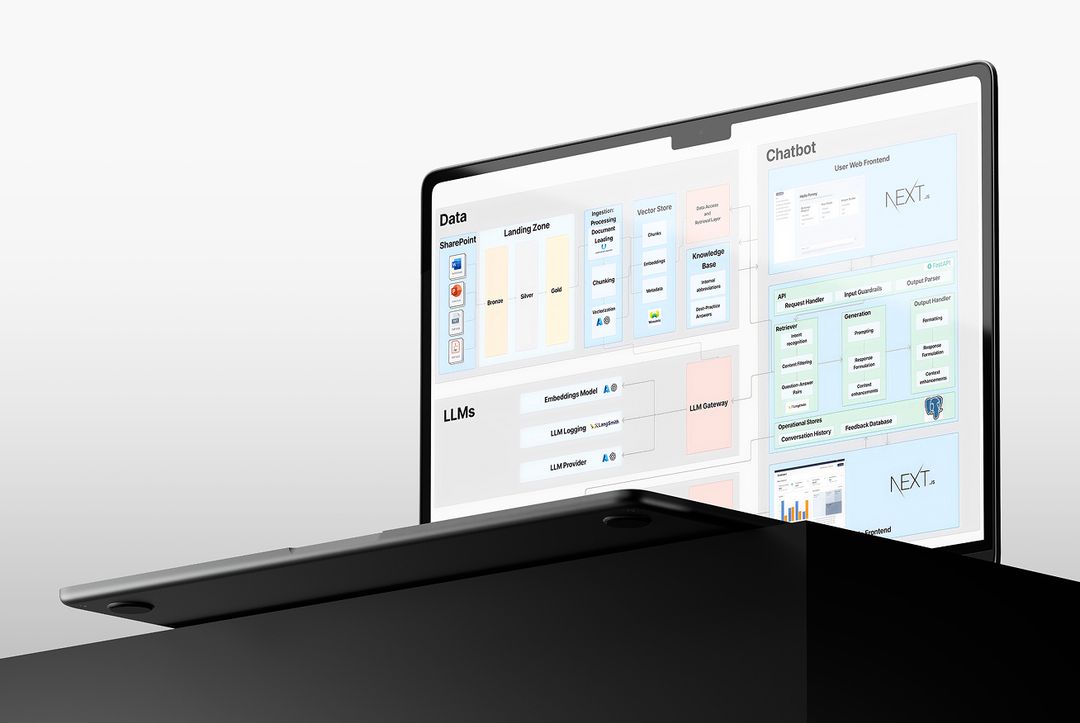
TUM took it over as a full implementation project from there, and our founder ran it as Co-Lead and SCRUM Master: a team of more than ten, nearly a year, alongside Microsoft's education team and TUM's faculty. The hard part was never the chat window. It was that everything a student needs to know sits in different places, the website, the FAQs, SharePoint, faculty-owned stores, none of it searchable as one thing. So we built the system that pulls all of it together and answers in context: a TUM-branded front end that feels like ChatGPT, a retrieval pipeline that ingests every one of those sources, a vector store that lets the model search them by meaning rather than keyword, an orchestration and observability layer across OpenAI and Azure models, and a reporting and feedback loop so it keeps getting better the more it is used.

We built it end to end and handed it over as pAIge.

What Followed

pAIge is live and has not stopped. It answers across the School of Management and now the Heilbronn campus too, gets a very high percentage of its answers right, and runs in continuous development through a student practicum. The practicum is the point, which was also proposed by our founder and he lead the first badge back then: it was built to outlast any one team, including the one that started it. The 72-hour hackathon that kicked it off, more than 50 students in a Microsoft office, is now a recurring contribution channel rather than a one-off.

TUM is where a lot of milbo comes from, in computer science, robotics, data engineering, which makes this one personal. Before there was a studio, there were three people sleeping on the floor of a Microsoft office, building one of the region's first university AI chatbots and convincing a 6,000-student institution to trust them with it. This is where milbo learned to ship AI. The studio that came after is built on it.

If you run an institution and want builders of that calibre, the kind of talent TUM produces and that has already shipped AI inside one, the next step is a call.

TUM
“Joshua's professionalism, discipline, and commitment have been invaluable to one of our leading AI projects at TUM School of Management. Resilient, innovative, solution-oriented.”
Barbara Tasch
Barbara Tasch
Managing Director · TUM

Want to build something like this?

Tell us what you're building — we'll get back within 24 hours.

Start a project